What if glowing molecules could synchronise, much like fireflies flashing in unison?
Researchers have discovered that molecules confined within tiny gold nanostructures can behave collectively, coordinating their interactions even under conditions where this was previously thought impossible. The finding challenges longstanding assumptions about how optical coherence forms and opens new possibilities for highly sensitive sensors, molecular photonics, and future quantum technologies capable of operating at room temperature.
Optical coherence describes a state in which light – or the molecules producing it – behaves in a highly coordinated way. It is the principle behind technologies such as lasers, advanced imaging systems and quantum communication. Traditionally, scientists believed this kind of coordinated behaviour required specially designed optical cavities that trap light for relatively long periods.
In the new study, published in Nature Nanotechnology, researchers showed that the molecules confined inside tiny gaps between gold nanoparticles (known as plasmonic cavities) can synchronise their behaviour even though light escapes from the system extremely quickly.
“By increasing the power of a laser, we observed the molecules switching from acting independently to behaving collectively,” said lead author Dr Rakesh Arul, Research Fellow at St John’s College and the Cavendish Laboratory. “At low laser power, the emitted light came only from the illuminated spot. As the power increased, the emission spread into a glowing halo far outside the laser beam, revealing that molecules separated by large distances were beginning to act together.”
The finding could contribute to new ways to build synchronised states of matter like superfluids at room temperature, and potentially be applied for advanced sensing, molecular photonics and quantum devices.
The researchers placed luminescent molecules inside gaps less than a billionth of a metre wide between gold nanoparticles and illuminated them with a continuous laser while observing how the molecules emitted light.
“By increasing the power of a laser, we observed the molecules switching from acting independently to behaving collectively”
The light the molecules emitted spread far beyond the illuminated area, while measurements confirmed that the molecules had become synchronised across the sample.
“What emerged was a synchronised dipole state where many molecules oscillate together as though they are acting as a single collective system, despite the fact that photons escaped from the system extremely quickly,” said Dr Arul.
Unlike a conventional laser, however, the emitted light did not become highly focused. The coordination existed mainly between the molecules themselves, while the light quickly lost its coherence after leaving the nanocavities.
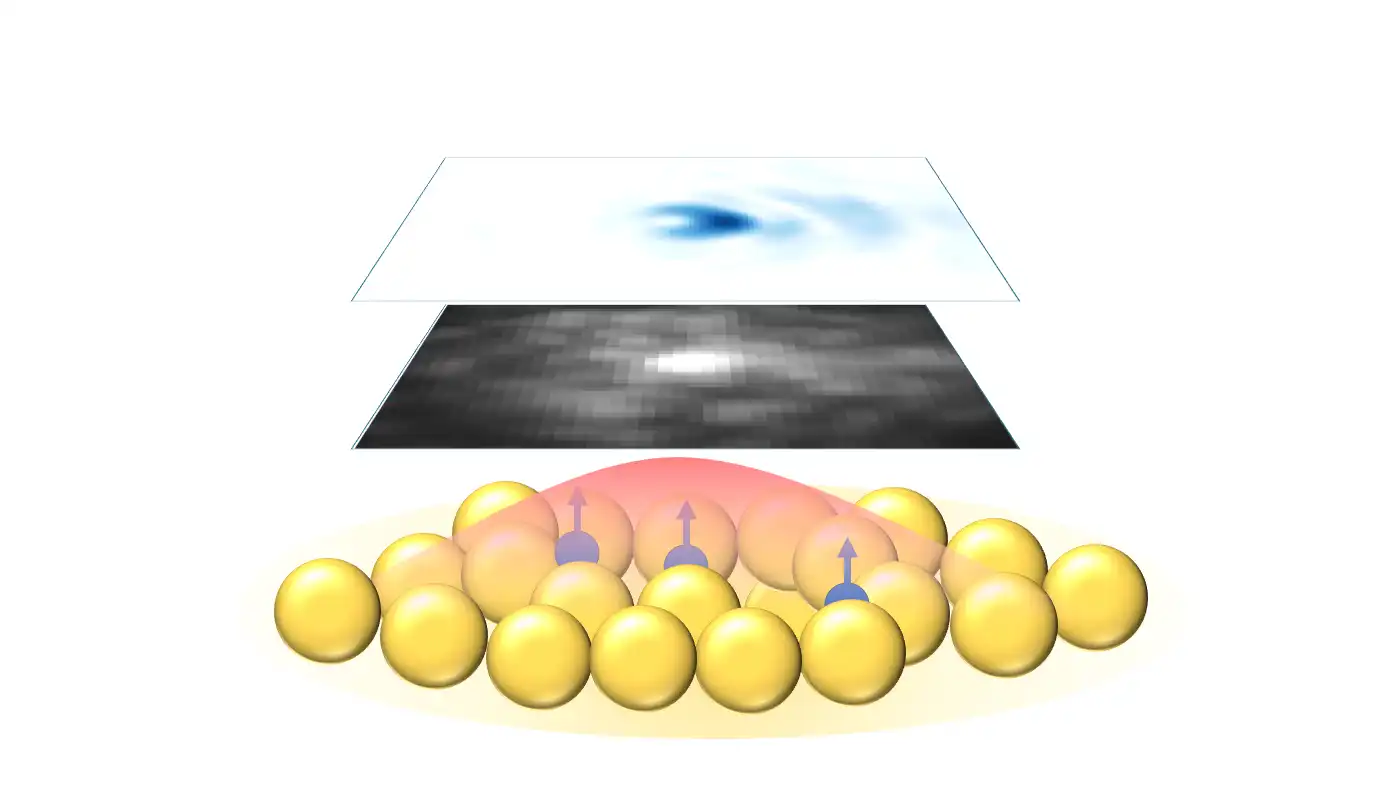
The researchers combined laser excitation, interferometry, and theory to look for evidence that the molecular dipoles were becoming synchronised. In collaboration with scientists at the University of St Andrews, state-of-the-art quantum optical theory was used to explain the results and reveal the source of synchronisation. They found that coherence arose because the molecules synchronised directly with one another through strong electromagnetic interactions within the tiny gaps between neighbouring gold nanoparticles, rather than through photons bouncing back and forth inside an optical cavity. Using interferometry, the researchers found that the molecules developed spatial coherence across the sample.
The scientists also saw spiral-like phase patterns called vortices. This indicates that, even when the system is synchronised, it still undergoes complex and interesting dynamic behaviour rather than settling into a simple, uniform state.
“The most surprising part was that this happened at room temperature in a highly disordered system where photons leak away extremely quickly – exactly the kind of environment where coherence is normally expected to disappear,” said Professor Jeremy Baumberg, who led the research at the Cavendish Laboratory.
“This is exciting because plasmonic nanocavities are not just enhancing molecular emission; they are mediating interactions between molecules and making them behave collectively, even in environments that were previously considered too disordered. This opens up a way to study coherent many-body physics in simply-assembled room-temperature materials.”
The researchers now plan to explore how changing the size of the nanogaps, molecule density, disorder and optical coupling affect the synchronised state. They also want to explore other emitters, including molecular qubits and colour centres, to see whether plasmonic nanocavities can enable future room-temperature quantum photonic platforms.
Reference
Arul, R, Fowler-Wright, P, Børresen, L et al. Coherent room-temperature dipole synchronisation in plasmonic nanocavities. Nat. Nanotechnol. (2026). https://doi.org/10.1038/s41565-026-02242-w