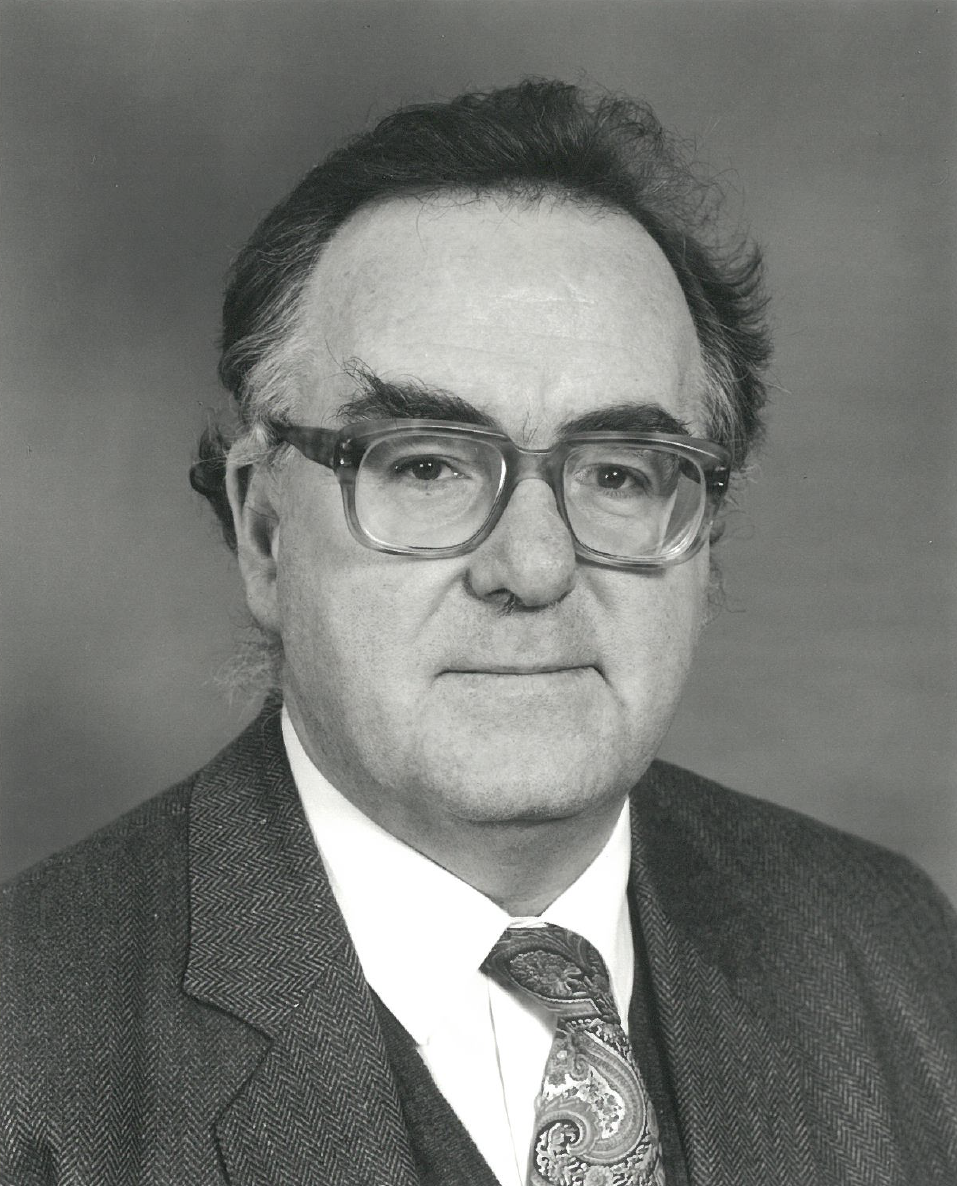
Dr Ben Garling MA PhD ScD, Emeritus Reader in Mathematical Analysis and a St John’s Fellow in Pure Mathematics, died on Saturday 6 December at the age of 88.
Having studied as an undergraduate and postgraduate at St John’s, he was elected to a Fellowship in 1963. He was a Tutor in the 1970s, and from 1987-91 headed the College Fellowship in the role as President.
He wrote key Mathematics course textbooks, teaching generations of undergraduates the joy of maths, and from 1984-91 was Head of the University’s Department of Pure Mathematics and Mathematical Statistics.
Dr George Reid, a friend and Fellow in Mathematics at St John’s, said: “Ben was a pillar of the College: scholar; research student; Fellow; College Lecturer in Mathematics; Director of Studies; Tutor; President, and then Senior Fellow. He has been one of those on whom the College could – and did – absolutely rely.”
Dr Garling taught undergraduates for more than half a century and wrote three volumes of the key textbook series, A Course in Mathematical Analysis, published by Cambridge University Press. Reviewing the first volume in its MAA Reviews, the Mathematical Association of America called Dr Garling ‘a gifted expositor’, adding: “The book under review really conveys the beauty of the subject, not an easy task.”
Dr Garling’s other important mathematical books include Inequalities: A Journey into Linear Analysis, Galois Theory and Its Algebraic Background, and Clifford Algebras: An Introduction.
From 1996-97 he was University Senior Proctor, a historical disciplinary and ceremonial role at Cambridge dating back more than 800 years. Similarly to his roles in College, he was ‘indispensable within the University’, said Dr Reid.
“A University Lecturer in Mathematics, then Reader in Analysis, but with a breadth of interest well beyond that, writing off the conventionally beaten analytic track on Galois Theory and Clifford Algebras. Head of the Department of Pure Mathematics and Mathematical Statistics and – somewhere along that crowded way – Senior Proctor.”
After spending his secondary education at Highgate School, Dr Garling sat the Entrance Scholarship Examination at St John’s College in 1954 and was awarded a major scholarship. However, he did not start his BA degree at St John’s until 1957.
“Youthful study beside the Cam did not immediately follow, for those were days of National Service and on leaving school he entered the Army, where he rose to the rank of Sergeant: a further testament to his character and ability,” said Dr Reid.
“Very sadly his last years were marred by blindness, which he bore with quite remarkable fortitude, and until the end it remained a joy to visit him at home for an hour’s conversation. Sometimes – but quite rarely – about Mathematics.
“What else was there to talk about? We had the past and we had the College, and what more does a person need? We never once found ourselves lost for something to say.”