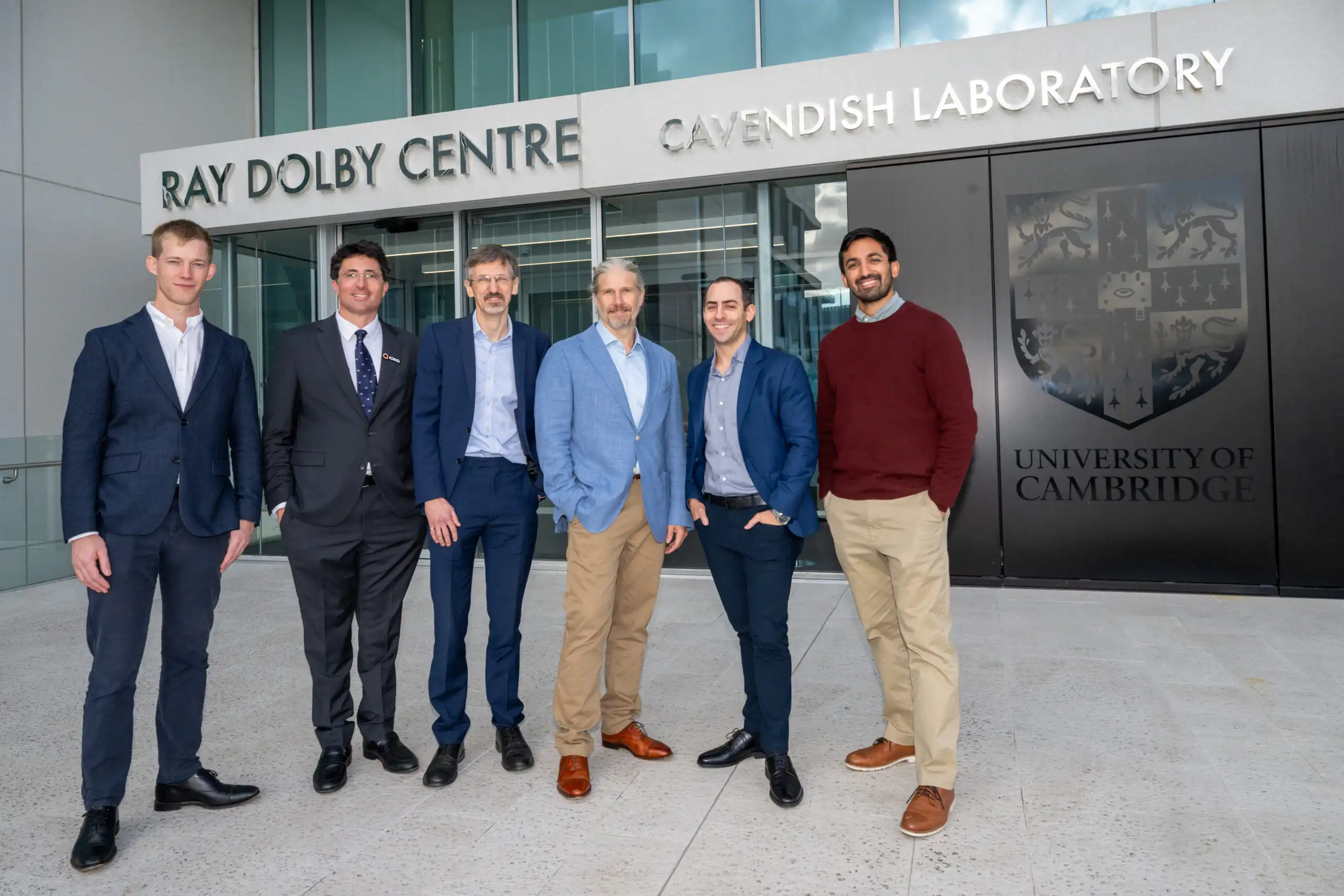
Physicists from St John’s College are among the first researchers awarded major grants by the new IonQ Quantum Innovation Centre at the University of Cambridge, supporting ambitious projects that could help shape the future of quantum technology.
St John’s Fellows Professor Mete Atatüre, Head of the Cavendish Laboratory, and Dr Dorian Gangloff, Associate Professor of Quantum Technology, have each won separate project funding from the new centre, which has been launched as part of a 10-year partnership with technology company IonQ.
“The official launch of the IonQ Quantum Innovation Centre is an exciting milestone in our partnership with IonQ, which will help Cambridge and the UK stay at the forefront of the quantum revolution,” said Professor Atatüre, who is a College Lecturer in Physics, and Director of Studies for Physics and Astrophysics, and for Mathematics for Natural Sciences at St John’s.
“The announcement of the first round of the funded research projects celebrates the depth and breadth of expertise and talent at Cambridge and will accelerate our impact in quantum science and engineering.”
The new centre housed in the Department of Physics’ Ray Dolby Centre provides significant funding for investigator-led blue-skies as well as translational research across quantum technologies, spanning biology, medicine, pharmacology, engineering and data science.
The centre will host a state-of-the-art 256-qubit (quantum bit) IonQ quantum computer, due to be deployed at the University by summer 2027. A qubit is the basic unit of information in quantum computing that forms the core building block for quantum technologies such as processors, sensors, and networks.
“The announcement of the first round of the funded research projects celebrates the depth and breadth of expertise and talent at Cambridge and will accelerate our impact in quantum science and engineering”
Nine initial research projects across Cambridge have been awarded funding,bridging the gap between hardware engineering and multi-disciplinary applications.
Professor Atatüre’s project, titled ‘Fully integrated diamond SnV PIC’, will address key challenges in quantum computing. Quantum networks are a key enabling technology for applications including distributed quantum computing, secure quantum communication, and networked sensing. Practical large-scale networks will require nodes containing hundreds to thousands of qubits, making it essential to increase the number of optically addressable qubits within each node.
His work will investigate scaling memory-based quantum network nodes by developing an integrated photonic architecture – which uses photons to generate, transport and detect information at the speed of light – for tin-based optically active spin qubits in diamond.

Dr Gangloff,who is leader of the Quantum Engineering Group and St John’s College Lecturer in Natural Sciences (Physical), is co-leading a project at the Cavendish Laboratory titled ‘Deterministic fabrication of solid-state quantum memory arrays (TinAct)’.
Quantum technologies will rely on networks of quantum memories that can store and share quantum information. This project aims to overcome a major manufacturing challenge by using laser pulses to activate individual quantum memories inside diamond chips while monitoring their formation in real time.
The approach could enable the creation of large arrays of quantum memories and improve the manufacturing yield of nanoscale interfaces between qubits and photons.