An academic who created ‘powerful’ new ways to study algebraic geometry has been awarded a prestigious Whitehead Prize from London Mathematical Society (LMS) – the UK’s learned society for mathematics.
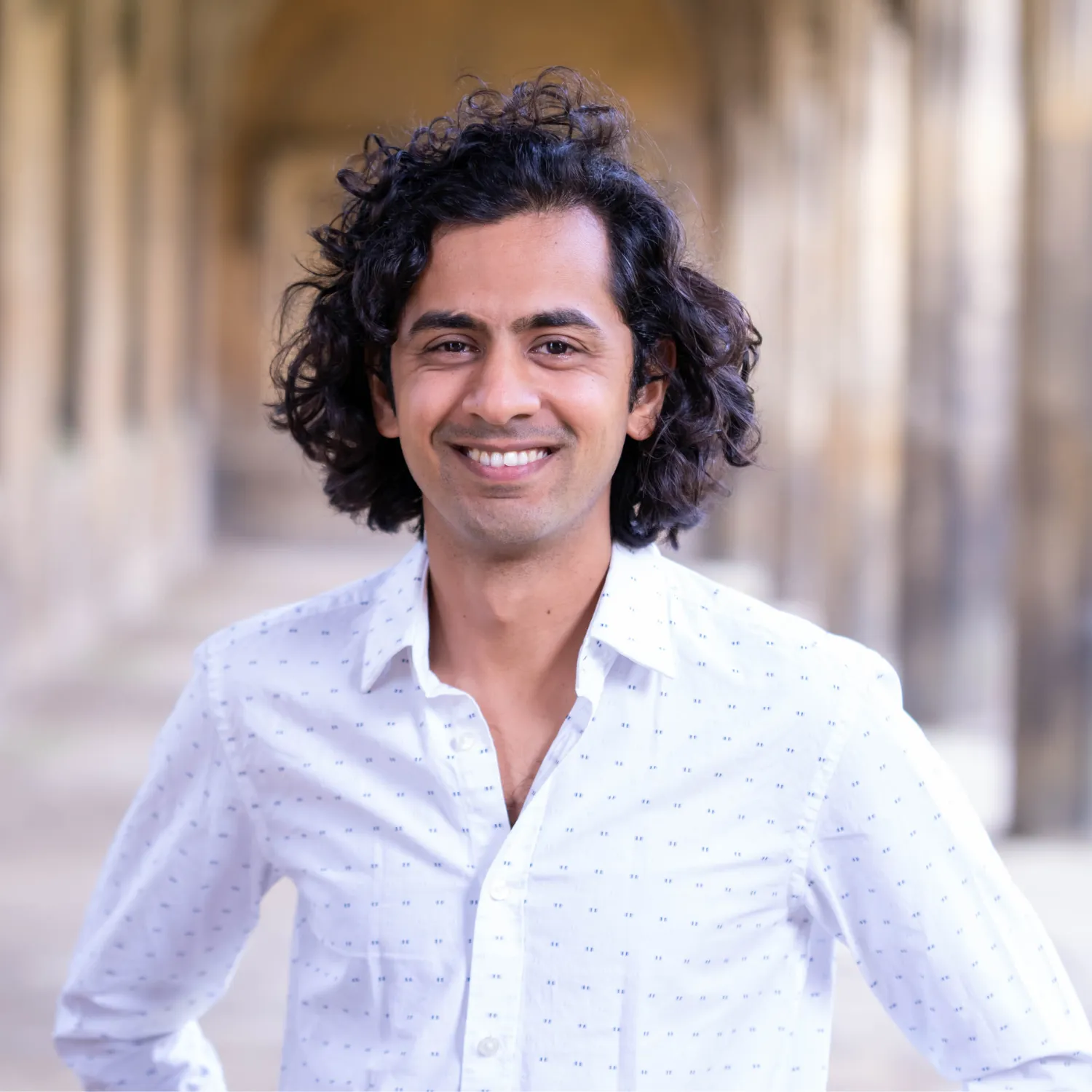
Professor Dhruv Ranganathan, Professor of Algebraic Geometry in the Department of Pure Mathematics and Mathematical Statistics, and a Fellow of St John’s, has been honoured for his groundbreaking work in logarithmic algebraic geometry – a theory that allows questions on smooth algebraic varieties to be studied by degenerating them until they break into simpler pieces on which the problem is easier to study.
“Lifting results from the pieces to the original variety requires a vast and forbidding body of technical foundations, many of which Ranganathan has developed himself,” said the prize citation for Professor Ranganathan.
“Ranganathan is an extraordinary algebraic geometer with boundless energy and tireless dedication to the mathematical community. His singularly productive research and prolific output are matched only by his commitment to mentorship of young researchers.”
Professor Ranganathan, who is a Director of Studies and College Lecturer in Pure Mathematics at St John’s, said: “The list of previous winners of the Whitehead Prize includes so many people I really look up to, so it’s amazing to be on the same list as them.
“Cambridge and St John’s have been wonderful places to do mathematics over the past seven years. Almost all the work mentioned in the citation was done in collaboration with friends and colleagues.
“As for many mathematicians, mathematics is at its most fun for me when I get to share ideas with other people, and I’ve learned an enormous amount from everyone I’ve had the chance to work with.”
LMS is the UK’s learned society for mathematics, dating back to 1865. Its purpose is the advancement, dissemination and promotion of mathematical knowledge, both nationally and internationally, and its annual awards recognise outstanding achievements and contributions across the mathematical sciences.
In March, Professor Ranganathan won a University of Cambridge Pilkington Prize for his 'exceptional' teaching.
“Ranganathan’s singularly productive research and prolific output are matched only by his commitment to mentorship of young researchers”
In his work, he has unified algebraic, tropical and moduli theories, creating powerful new methods for studying geometric degenerations and curve counting theories.
Logarithmic or ‘log’ geometry is ‘a difficult mix’ of ordinary algebraic geometry and a combinatorial shadow of it called tropical geometry.
“The latter governs the combinatorics of the intersections of the pieces that we break a variety into and has, over the last 30 years, developed into a large field – another in which Ranganathan is a world leader,” reads the prize citation.
“But log geometry is much more than the sum of algebraic geometry and tropical geometry; they are such different areas which have proved very difficult to merge. It has taken decades for mathematicians to find the right approach and for a mature theory to emerge. Lots of the objects, constructions and techniques of algebraic geometry have slowly been lifted to the log realm over many years of missteps and hard work.
“Ranganathan is the master of combining log geometry with moduli theory – the study of spaces that parameterise geometric objects of some sort. His work has given us a much better understanding of how whole moduli spaces degenerate as the objects they parametrise degenerate, how to put log structures on the moduli spaces themselves, and how to use log geometry to study these moduli spaces.”
Professor Ranganathan’s recent work has created some of the most powerful tools in Gromov–Witten theory (counting maps of curves to algebraic varieties) and Donaldson–Thomas theory (counting embedded curves in algebraic varieties, or vector bundles and sheaves over algebraic varieties). This has enabled researchers to fully develop ‘log-GW’ and ‘log-DT’ theories – allowing computations to be done on the simpler pieces of a degeneration – and great progress on showing how the two theories contain the same information.
Professor Ranganathan said he is ‘incredibly grateful’ to receive the prize, which was announced at the LMS Summer General Meeting on 3 July. Winners will be awarded their prizes at the LMS Annual General Meeting on 20 November. Among his collaborators, he added: “I’d especially like to thank Davesh Maulik, who I’ve been very lucky to work with on much of the research recognised by this prize.”
Find out about studying Mathematics at St John’s